Yapım Tarihi - 1999
Süre - 01:00:00
Formatı - 16mm, Belgesel
Yönetmen - Aysun Bademsoy
Kameraman - Sophie MAINTIGNEUX
Kurgu - Aysun Bademsoy, Bettina BLICKWEDE
Yapımcı - Harun FAROCKI
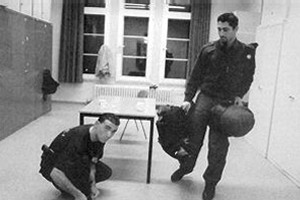
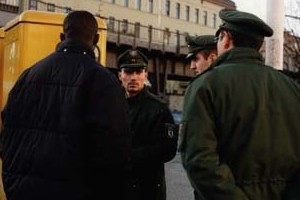
In this film the director observes policemen in action in the Berlin districts
of Kreuzberg and Neukölln. In the 5th administrative precinct, policemen from
immigrant families are also performing their duty, three from Yugoslavian
families and two from Turkish families. Just as 23-year-old Bürol B. they all
endeavour to do their work like any other German policeman in this section of
the city with its high proportion of foreigners, and nevertheless when on duty
as well as in their private lives they have to come to terms with cultural,
social and sometimes also moral conflicts.
Aysun Bademsoy strikes an exact balance between closeness and distance, in order
to direct our attention to the deeper layers of the conflict of living between
cultures, for which there are no simple words and also no simple solutions.
10. Uluslararası Kerela Film Festivaline Katıldı. 2005
Kaynak
Kerela Film Festivali web sitesi
La réalisatrice Aysun Bademsoy observe le travail des policiers dans les
districts berlinois de Kreuzberg et Neukölln. Dans ces quartiers, il sont
quelquefois issus de l’immigration - l’ « unité d’intervention no 5 », Par
exemple, compte trois Yougoslaves et deux Turcs qui s’efforcent de faire leur
travail comme n’importe lesquels de leurs collègues allemands. Pourtant, dans
cette zone qui compte un haut pourcentage d’étrangers, ils doivent faire face à
de nombreux conflits d’ordre culturel, social et quelquefois aussi moral, tant
dans leur vie professionnelle que dans leur vie privée.
Cinematekette Türk-Alman film günleri....
Bağımsız ve sinema tarihine mal olmuş yapımları gösteren Cinemateket'te Ocak ayı
sonunda Almanya'da yaşayan Türk yönetmenlerin filmleri gösterilecek. 10.01.2005
Saat- 15:39
Kaynak
http://haber.dk
Drei ehemalige Ausländer als deutsche Polizisten, im 3. Zug einer Hundertschaft
in Berlin, Kreuzberg/ Neukölln. Zwei ehemalige Türken, ein ehemaliger Jugoslawe,
inzwischen deutsche Staatsbürger und damit berechtigt, im Polizeidienst zu
arbeiten. Sie sind hier geboren und aufgewachsen, in diesen Stadtbezirken mit
besonders hohem Ausländeranteil, die jetzt ihr Einsatzgebiet sind.
Hier begegnen sie ihren Landsleuten, müssen oft polizeiliche Maßnahmen gegen sie
ergreifen und hoffen, dabei niemals auf Freunde oder Verwandte zu treffen.
Manchmal werden sie von gleichaltrigen Ausländern als Verräter beschimpft.
Andere sind froh, daß diese Staatsdiener ihre Sprache sprechen, ihre Kultur
kennen, ihre Bedürfnisse besser verstehen.
Der Film begleitet sie bei ihren Tag- und Nachtschichten, ihrem Alltag als
deutsche Polizisten. Er registriert dabei ihre Meinungen und ihre Planungen für
die nächsten Einsätze. Zeigt ihre Konflikte zu Hause, mit den Eltern und ihrer
ausländischen Herkunft, beim ständigen Zusammenstoß der Kulturen. Und verweist
auf ihre deutschen Kollegen und darauf, daß sich die einen wie die anderen
umstellen müssen.
It’s the last game of the season for Berlin football club Hertha BSC. The fans
are on the way to the stadium, bawling out right-wing slogans as they ride the
underground. A police escort accompanies them to the footballground; among the
police officers is Bürol, a twenty-three-year-old former Turk. Later, as the
team are on their way to their hostel, he says- “I won’t piss off just because
these people want me to. Why should I? I was born here and I will be a police
officer until the end. I’m fighting for our system.“ Bürol belongs to Section 3,
which is stationed in the Berlin districts of Kreuzberg and Neukölln. There are
twenty-eight men in his troop. Five police officers in this group were once
foreigners; they include three former Yugoslavians and two former Turks. They
all had to take out German citi-zenship in order to join the police force and be
sworn in as servants of the German state. Most of these officers were born and
raised in Berlin, some-times even in the districts which have now become their
beat. There is a large concentration of foreigners living in Kreuzberg and
Neukölln. Here, these officers encounter plenty of people from their own
countries and are often obliged to apprehend them during the course of their
duties. Sometimes they talk to them in their mother-tongue. But, as Bürol B.
later commentsin the film, “. . . we are on the ‘good’ side. Just like cops and
robbers.We are the good guys and the others are the baddies.“At the same time,
they hope and pray that they won’t ever have to appre-hend any of their own
friends or relatives, because this would plunge theminto a conflict that would
be extremely hard to deal with. From time to time, foreigners of the same age as
these officers hurl abuse at them, calling them ‘traitors’. Older members of the
community, however, are pleased to note that here, at last, are police officers
who Can speak their language, who have an intimate knowledge of their culture
and are in a better position to understand their point of view. Production notes