Sesimi Duyan Var mı? (The Last Hope: Can Anyone Hear me?)
Yapım Tarihi - 2024
Süresi - 00:07:00
Format - Kurmaca, Renkli, Türkçe
Yönetmen - Tuğçe Kayaarası
Zeynep, who moved from Samsun to Adıyaman due to her husband's transfer, lost
her home and family in the February 6 earthquake. Zeynep was newly pregnant
during the February 6 earthquake and has to live to give birth to her baby, a
souvenir from her husband that keeps her alive and connects her to life. After
this incident, Zeynep started working at a hotel in a small coastal town on the
Black Sea. The owner of the hotel, Mr. Mustafa, took her in and gave her a small
house and a job for her to stay in. A few months pass. It's almost time for
Zeynep's birth. Zeynep continues to survive for her baby. Years pass after Duru
is born. Duru's school time is approaching. Zeynep tries to make a living by
doing several jobs at the same time. However, she cannot afford to buy books,
notebooks and uniforms for Duru. What she earns is not even enough to live on.
Zeynep is desperate and tries to find a way out.
5. Fotofilm Kısa Film Festivali, Kısa Film Yarışması, Yarışma Filmi. 2024
Kaynak
Fotofilm Kısa Film Festivali
Director Statement
First of all, it was a job that was shot with great effort for two months,
working day and night in the preparation, shooting and post-production stages,
and that I worked very fondly on. The theme of our movie is hope. I tried to
explain from my own perspective the struggle for life and survival of a woman
who lost her husband and child in the February 6 earthquake, the emotional
trauma she experienced and her struggle to survive for her baby, and the
troubles and sadness she experienced. In this project, it is aimed to increase
society's sensitivity to the survival struggle of women on the threshold of
life, and to make visible the position of our women in society, their successes,
and the difficulties and troubles they experience. The shooting locations,
costumes, accessories and visual aesthetic structure of the film were determined
by thorough research and careful selection during the preliminary preparation
process.
I tried to be extremely natural and original in the shooting techniques in the
film. tried to choose natural and real places, costumes and costume colors
appropriate to the spirit of the places, and accessories in line with the
structure of the places. In actor management, I allowed the actor to freely
interpret his own character, again from a natural, realistic perspective. I took
the actor to the locations before the shooting so that he could identify with
his character. In this way, I enabled him to both focus on the character easily
and internalize it. In the cinematography management, I tried to reflect the
mood and psychology of the character by using natural light and partial lighting
in the interiors. I tried to establish a holistic perspective in terms of
technique and content by making use of natural light, that is, daylight, in
outdoor spaces. I strengthened the spatial fiction by using archive images about
the earthquake. I tried to emphasize the traumatic situation of the character
through editing, narrative style, shooting techniques and the aesthetic
structure of the film. The trauma in the character's inner world, emotional
conflict and the troubles, difficulties, pains she has experienced, getting up
early in the morning and working until the evening despite her pregnant belly,
the helpless situation she is in, and her struggle to survive for her baby that
connects her to life, are seen both from the perspective of an objective
outsider and from the director's perspective. I tried to interpret.
In the visual structure of the film, I preferred cold colors before Duru was
born, and warm colors after Duru was born. While Zeynep was more introverted
before Duru was born, we can say that after Duru was born, Zeynep recovered more
psychologically and became more extroverted. Zeynep confronts her past in the
scene where she writes in her diary. Even though life is difficult, it must
continue for him. But the pain is always inside. Here we move on to flashback
scenes and go into Zeynep's inner world between dream and reality. Through his
eyes, we see houses leaning sideways, a mosque, a doll, the inside of a
collapsed house, and the work of a construction machine removing debris during
the February 6 earthquake. In these scenes, a new space fiction was created with
the use of an ebb and flow, depressive and traumatic, psychological, poetic
narrative language and color, especially depending on the character's mood. Here,
Zeynep confronts her inner world and questions her past. 9 years pass. I
emphasized the passage of time with the image of the cliffs. Rocks symbolize
long time, years and difficulties. The rocks also symbolize Zeynep's struggle
for life on the edge of life and the sea.
Duru was born, grew up and went to primary school. After Duru is born and grows
up, Zeynep tries to find a way to send him to school. What they earn is barely
enough to pay for food. He cannot afford to buy notebooks, books and a school
uniform for Duru. Even the money he earns by doing extra work is not enough to
make ends meet. This difficult situation that Zeynep is in is explained from a
natural and realistic perspective in terms of technique and content. After Duru
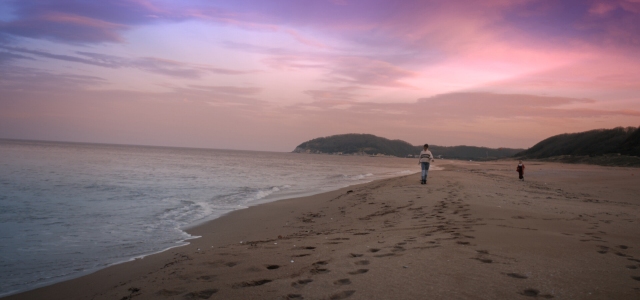
is born, we see him for the first time in the seaside scene. Here, Duru shows
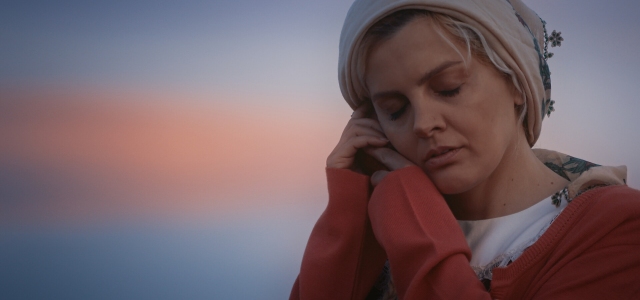
her mother the seashells she collected by the sea. Zeynep takes the seashell and
puts it to her ear and hears the voices of her daughter who died in the
earthquake... In this scene, we see Zeynep's inner pain and longing for her
daughter by establishing a metaphorical, imaginary and poetic narrative. He gave
the name of his daughter, who died in the earthquake, to his daughter, who is
now alive. The seaside and seashells are metaphorical and symbolic symbols of
hope, eternity and depth. In the scene where Zeynep puts the seashell to her ear,
we see her confronting the pain she experienced in the past and her emotional
fluctuations with the voices coming from her daughter who died in the earthquake.
Desperation and impasse pushes the character to find a way out and a solution in
his inner world. We see how strong Zeynep's spiritual side is in this scene.
After this scene, Mustafa, the owner of the hotel, comes to the place where
Zeynep sets up a stall and sells her handicrafts and products. He gifts Duru a
school bag, school notebook, books and a uniform. Mustafa, who overheard what
Zeynep said while she was having trouble with her neighbor in the previous
scenes, wanted to make a surprise. Zeynep and Duru were very happy. Mustafa, who
noticed the situation Zeynep was in and wanted to help her even a little, acted
possessively and protectively towards Zeynep, who had been working with him for
years.
In the final scenes, Zeynep combs Duru's hair and prepares her for school. In
the last scene, Duru comes running with the report card in his hand. Zeynep also
hugs her daughter. Zeynep looks at Duru's report card and all his grades are
very good. Mother and daughter hug and leave the frame. In the final part of the
film, the warm and intimate relationship between mother and daughter is depicted
from a natural, realistic and dramatic perspective. The music of the film has a
supporting and empowering aspect to the narrative and reveals the emotional and
dramatic side of the film.