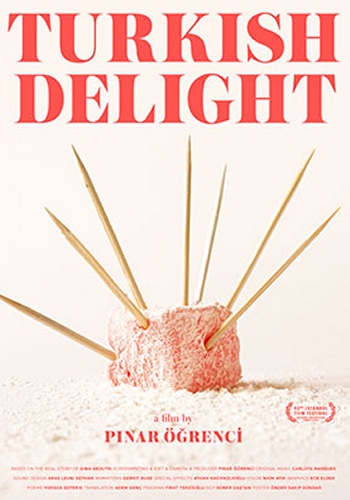
Yapım Tarihi - 2023
Süresi - 00:31:00
Format - Belgesel, Renkli, Türkçe
Yönetmen - Pınar Öğrenci
Kurgucu - Pınar Öğrenci
Özgün Müzik - Carlota Marques
Animasyon - Gerrit Kuge
Yapımcı - Pınar Öğrenci
Dünya Hakları - Pınar Öğrenci
Turkish Delight, Türk mutfak kültürünün en önemli sembollerinden biri olan
lokumun, Anadolu’nun batısından Yunanistan’ın Syros Adası’na uzanan üretim
hikâyesini anlatıyor. Arapça’da "rahat-ul hulkum" ve Yunanca’da "lokumi" olarak
anılan "lokum", ulus fikrinin yayıldığı 19. yüzyılın sonunda "Turkish Delight"
olarak anılmaya başlarken kısa bir süre sonra başlayacak savaştan kaçan
mültecilerin ekmek kapısı olur. Anadolu ve adalardan gelen Rum mültecilerin
emeğiyle inşa edilen Syros Adası’nın hikâyesinden bir bölümün anlatıldığı film,
yüzyıllarca bir arada yaşayan halkların birbirinden zorla koparılmasına
odaklanır. Kurtuluş Savaşı sırasında İzmir ve İstanbul’dan kaçarak Syros
Adası’na sığınan iki Rum ailenin zorla yerinden edilme hikâyesinin anlatıldığı
film, farklı kuşaklardan gelen iki çiftin hayatta kalma hikâyelerini bir araya
getiriyor. İmgelerin parçalı çokluğuyla görselleşen anlatı, anavatan ile varış
limanı arasında kalan mülteciler için ikiye bölünmüş tarih yazımına, parçalanmış
kültürel ilişkilere ve psikolojik kayıp manzarasına işaret ediyor.
42. İstanbul Film Festivali, Ulusal Belgesel Film Yarışması, Finalist. 2022
Kaynak
İstanbul Film Festivali
Pinar Öğrenci’s ‘Turkish Delight’ at Colomboscope muses food history and war
Multivalent experiences of migrants and circulation of cultural history are at
the centre of Berlin-based artist and writer Pinar Öğrenci’s video-installation
for Colomboscope 2021.
As the myriad hues of real-time human experiences on exile, dispossession and
migration dominated the discussions on media portals and news feeds, more than
half a decade back in 2015, the world of art responded to the situation with a
reinvigorated interest in identifying the artistic production, concept-metaphor
and visual language with a potential to represent the manifold nature of
dislocation. The displacement served as a fecund moment to critique the promise
of solidarity implicated in the neo-liberal policies and globalisation. Once
under the lens of reassessment, the political economy of free trade was
witnessed in conjunction with the nationalistic urgency to secure borders. To
disrupt these practices of confinement and restriction, human history,
punctuated by the events of departures and arrivals across the barbed borders
and slippery shores, offered the artists a way to extend a hand of solidarity
toward the vulnerable. The unique stories of survival transcend their singular
geographical and temporal framework to articulate a collective language on loss
and pain. Leafing through pages of such a history on human resilience in the
face of migration and state violence is the art practice of Berlin-based artist
and writer, Pinar Öğrenci. The material culture in the hands of the artist is an
extension of peripatetic life —anchored by enforced migration — to unravel the
personal stories in the large political scheme of things.
Öğrenci’s latest video installation, Turkish Delight, a part of the seventh
edition of Colomboscope 2021, Language is Migrant, traces its stories that
travelled from Western Anatolia to Syros Island. Öğrenci's interest as an artist
with the cultural intricacies of the material speaks to the curatorial theme of
Colomboscope: a quest to explore the multifaceted manifestation of language,
entrenched within the itinerant journey through territory and time, across the
disciplines. The festival, curated by Anushka Rajendran with Artistic Director,
Natasha Ginwala, draws its title from the eponymous poem-manifesto by Chilean
artist and poet, Cecilia Vicuña. It questions the teleological limits of a
language in an effort to reflect on its agentive potential of metamorphosis.
Interestingly, it was when Vicuña wrote this piece for the documenta14, Öğrenci
had initiated the Turkish Delight project in 2017 as a part of a three-month
residency program in Athens organised jointly by Perpetuum Mobile and the Athens
Biennale. Concomitantly, these projects were conceived when global politics was
embroiled in the debates on migration and the refugee crisis, especially in
Europe.
During the residency, Öğrenci closely worked with the dessert-manufacturer
immigrants from Asia Minor. In an interview with STIR, the artist states, “After
I met with Dina Skoutri, a lokum (Turkish Delight) manufacturer living in Syros
Island, the project tended to concentrate on lokum production. I thought that
the migration story of the Skoutri Family, who forcibly migrated from Istanbul
and Izmir to Syros Island during the Turkish Independence War, and the lokum
culture they brought - already existing in Syros since the beginning of the 19th
century - could be a symbolic tool, a metaphor, to understand both the forced
separation of people who lived together for centuries and their ongoing
connections.” Akin to taste buds, the words are expressions of intimacy and
familiarity that open a possibility for togetherness in a newfound home. Öğrenci
admits, “It was thanks to lokum that the Skoutri Family established a
relationship with the local people of Syros; serving lokum to the islanders at
celebrations such as weddings, birthdays and baptism ceremonies, Asia Minor
immigrants were gradually welcomed by the locals.” The artist, in a similar vein,
with her installation transcends the idea of language to culinary delight — the
evidence of a network of the human stories and collective movements.
Crucial to the affirmation Language is migrant is the idea of transmutation. The
state of in-flux as opposed to being engulfed in a bracket is a negation of the
fixed essence of the identity — food and language salient identity-makers. Along
with the circulation of people, the cuisine travels across the shores, so does
the language to be reconfigured in the land of new belonging only to add a
sequence of spirals to the history of people and their culture. Öğrenci offers a
detailed etymological account of lokum and its history of consumption to
underscore its multifarious past. “Etymological roots of lokum, which is
produced in the whole Middle Eastern geography, stems from rahat ul hulküm / 'the
thing used to relieve throat' in Arabic and lokum is still known as rahat lokum
in the Balkans today.” Öğrenci mentions, “According to one account, lokum was a
small dessert produced initially to mitigate the bitter taste of the opium taken
by Ottoman Janissaries to calm their mind driven by the after-effects of war.
Lokum, with a gradual passage of time, travelled to find a well-sought place as
a dessert on the table spread of the palace in Istanbul and developed its
present-day rich content.”
The integral ingredient of the lokum, a special gum, was a native of the Chios
Island that rightly enhanced the richness of not just lokum, but also a variety
of desserts. This explains the presence of a significant population of Greeks of
Chios, who migrated due to the Turkish War of Independence, as the producer of
lokum during the Ottoman Empire. Notably, the group had a large stake in the
economy of Syros Island. Furthermore, Öğrenci shares another anecdote around
lokum, “During the German Occupation of Greece, at the time of Second World War,
and the Greek Civil War, the insurgents communicated with each other by hiding
letters under the packages of lokum and posted them via mail.”
Besides oral history and archival images on the production of lokum, the key
segments of video installation, Öğrenci incorporates images of the packages of
Turkish Delight from the Industrial Museum of Ermoupoli in Syros to set the
historical contextualisation of lokum. For the artist, the museum at a
particular geographical location and its collection is not a simplistic site of
display and reception, but an invitation to excavate a fragment of memory,
otherwise silenced by politics of nation-builders. Öğrenci states, “The
Industrial Museum of Ermoupoli in Syros does not set forth the connection of the
lokum culture with Anatolia and Ottomans in its narrative around lokum but this
is understandable when we take into account the relationship between museums and
nation-building.” But what caught the attention of Öğrenci, which prompted her
interests toward lokum, was the absence of rigorous academic research on the
history of the culinary symbol. The collective memory, a tool of resistance
against the unsettling erasure, for Öğrenci could make a room for an exchange of
conversation to answer key questions such as, “Who were the first famous candy
and Turkish delight producers during the Ottoman Empire; how did the first lokum
packages and manufacturer brands look like; what were the production tools, have
these pieces of equipment managed to survive until today?”
Not limited to archival knowledge systems, but a combination of both lived
experience and labyrinth of political history inform Öğrenci’s artistic practice
of which material culture takes the spotlight. Having forcibly migrated from
Turkey to Germany due to the political reasons in 2018, Öğrenci translates her
everyday reality to navigate and negotiate the relationship of belonging through
the intangible memory around the home and objects of care. The video
installation A Gentle Breeze Passed Over Us, like Turkish Delight, is a lyrical
take on the notions of struggle and survival of a refugee. Produced in 2017, A
Gentle Breeze Passed Over Us is about an Iraqi musician refugee who had to drop
his instrument oud into the sea while trying to cross the Mediterranean.
Moreover, the two works are articulations of a spate of emotions, even if
separated by time, to underscore human suffering in the face of political apathy.
“The work is based on the story of a young musician I met in Vienna. With the
image of an oud slowly slipping away in the Mediterranean, I tried to depict the
remains of an ancient culture and the search for a place, for a 'home’. In both
works, we see the Mediterranean as a migration route, a commonplace of journey.”
Often the artist, following the popular fashion of global contemporary art,
eschews the tapestry of local sensibility with nonchalant thinking. To a
pleasant surprise, Öğrenci emphasises, “Lokum carries geographically unique
traits, and the global capital has a destructive impact on all small-scale
productions.” To abrupt the universalising rhetoric on the conditions of global
migration, Öğrenci harks on the history of Turkish Delight to reaffirm the
subjectivity produced and advanced under the alarming condition of human
transplantation.
Five years down the line, since the conception of Vicuñ’s Language is migrant,
the migration in the time of excruciating pandemic has acquainted the humans
with a form of mutation hitherto inexperienced. If human mobility is curtailed
to keep the spread of the virus at bay since it does not “respect the national
borders”, it has prompted creative minds to enable new forms of interpreting the
constellation of migratory realities. Against this backdrop, Öğrenci’s Turkish
Delight, featuring in the latest edition of Colomboscope, prompts the audience
to recognise a language of diversification, beyond the immediate terrain of
familiarity, to perform alternative mapping of migration, to identify the
complexity of human existence, to be perceptive to the ways of knowing the other.
STIR is the exclusive international digital-media partner of the seventh edition
of Colomboscope 2021, which is scheduled to take place in Colombo, Sri Lanka,
from 20-30 January 2022.