While none of the other films I saw during the Fourth Annual Turkish Film
Festival achieved quite the artistic level of the comic masterpiece "Sergeant
Shakespeare," all of them were useful windows into the complex reality of a
country that stands right now as a crucible between two powerful cultures on a
collision course. With the USA representing itself as the vanguard of a new
Crusade, it is understandable that the question of Turkish identity--either
European or Mideastern--will come to the fore.
With the Islamic-oriented (but not Islamic fundamentalist) Justice and
Development Party poised to take power in Turkey, these sorts of question are
posed even more sharply than ever. While little more than a travelogue, Binnur
Karaevli's 37-minute documentary "Cenneti Ararken" (Searching For Paradise)
addressed them from a personal angle. Karaevli is a 30 something woman who
learned English in Turkey to prepare her for either a job in Europe or the USA.
Departing from her home in Los Angeles, she flies back to Istanbul visit her
family and to search for Paradise Gardens, which epitomized the city of her
youth and all that was exceptional about her country. At the conclusion of the
film, she learns that the gardens have been razed in order to make space for a
restaurant and residential buildings. Only the name remains.
She walks around the city asking people if they are "European" or "Asian". To a
one, they insist that they are European. Only intellectuals like the novelist
Orhan Pamuk reply in a more ambivalent manner. In a March 27, 1995 Nation
Magazine review of his "The Black Book," one understands where Pamuk is coming
from:
"Hoja, having learned Western engineering from his slave, becomes obsessed with
making a huge weapon for the Turkish Sultan's military campaign in Europe. But
once constructed, it gets stuck in a swamp at the base of a gleaming white
fortress in Poland, which the Turks fail to take. Surely a statement against the
abuse of knowledge and the forceful taking of other cultures, this defeat also
reflects the real failure of the Ottoman Turks to conquer the West in the
sixteenth century, when their armies were stopped at Vienna."
Indeed, although Turkey never continued its march across Europe, only leaving
traces of its relatively benign precapitalist Empire in the Balkans, Europe did
eventually sweep across Turkey. The challenge that European hegemony mounted was
so overwhelming that the Turkish elite was forced to transform the country in
order to remain viable. Mustafa Kemal tried to eliminate all of the Islamic and
Ottoman traces in the country and model the country along modern European lines.
Today, as cat's paw of US imperialism in it's pending war against Iraq, we are
constantly reminded that Turkey is a "good" Islamic country as opposed to Saudi
Arabia and all the rest. Set in 1960 and openly gainsaying the benefits of
westernization, Semir Aslanyurek's "Sellale" (Waterfall) focuses on the ancient
Anatolian town of Antioch, where life appears to be the same as it was a
thousand years earlier. People depend on the waterfall to drive the stone mill
for turning grain into flour. When local officials bring in a US engineer (a
Turk pretending to a Western "expert") to supervise the modernization of the
wondrous waterfall along the lines of ambitious projects like the Boulder Dam,
their version of Paradise Garden is destroyed. Only a trickle can be seen after
the rocks above the falls are dynamited. The local power structure is revealed
to be as inept as the Westernizing officers in Pamuk's novel.
Two films both seemed to consciously reject the kind of optimism projected by
the Turkish elites as it lurches uncertainly toward assimilation with the West.
Orhan Oguz "Hersye Ragmen" (In Spite of Everything) is an unsparing look at a
recently released prisoner who lives on the fringes of Istanbul society in a
ramshackle apartment shared with an alley cat. With few personal and social
skills, he ekes out an existence as a hearse driver. When a woman recently
returned to Istanbul from a stint as "guest worker" in Germany tries to develop
a relationship with him, he can barely sustain a conversation let alone open
himself up to intimacy.
In Umit Unal's "9", nearly the entire action takes place in the interrogation
room of a police station where residents of a "respectable" Istanbul
neighborhood point fingers at each other during the investigation of the murder
of a young female "street person". The director implies that the murder is
emblematic of a deeper malaise in Turkish society that would explain the
acceptance of authoritarian rule by large sectors of the middle-class.
Unfortunately, both "Hersye Ragmen" and "9" are somewhat lacking in
entertainment values. While it is commendable that filmmakers put forward such
an unstinting view of their society, you cannot do this at the expense of what
makes film work as an art form. You need plot, dialogue and inventive
cinematography, which no amount of honesty can make up for.
Perhaps it was the example of such films that made "Sergeant Shakespeare"
director Sinan Cetin attack the notion that "Hollywood imperialism" was
responsible for the decline of the Turkish film industry. He stated that if you
make films that engage an audience, they would succeed commercially. Needless to
say, this is a universal challenge to filmmakers of any nationality.
Although Cuneyt Arkin's 1982 "Dunyaya Kurtaran Adam" (The Man Who Saved the
World--also commonly referred to as "The Turkish Star Wars") was not part of the
festival, it was shown at a Halloween fundraiser party and dance for the
sponsoring Moon and Stars Project. Whatever else one wants to say about this
film, nobody can ever accuse it of not wanting to entertain.
Best described as a cheap imitation of the George Lukas "classic", it is not
above including footage from the original, throwing all copyright considerations
overboard. Arkin also borrows/steals from "Raiders of the Lost Ark" as well,
spicing up his film with musical passages lifted directly from the Indiana Jones
movie.
It is a masterpiece in the same sense that Ed Wood's "Plan Nine From Outer Space"
is. It mixes together conventions from science fiction serials of the 1940s and
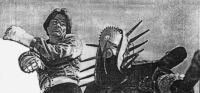
50s (as Lucas did) with Hong Kong martial arts action conventions. Made on the
ultra-cheap, the villains are dressed in fuzzy pink costumes of the sort worn by
baseball park mascots or appear to be improvised from whatever was lying around
the wardrobe department. The net effect is comic, just as was Jackie Gleason in
his appearance in the Honeymooners "Man from Outer Space" Halloween costume
cobbled together from household appliances, etc.
The Byzantine plot consists mostly of one kung fu fighting sequence after
another as the two heroes of the film, including Arkin in a Han Solo type role,
dispatch their evil enemies. Obviously lacking a penny for special effects, the
film uses a trampoline to propel the actors over the heads of their antagonists.
Adding to the overall sense of temporal and geographical displacement, the
battles are staged on location in the ruins of Cappadocia, an ancient Anatolian
region that was a center of the early Christian church and Zoroastrianism as
well. The space warriors chase each other from one 12th century crypt to another
without any attempt to explain the Christian relics on display. The final half-hour
of the film is a delirious mixture of crudely choreographed kung fu fighting
scenes, slapdash "death rays", slices of "Star Wars", fantastically costumed
extras who appear on their way to Mardi Gras.
"Dunyaya Kurtaran Adam" can be seen online at:
http://www.showtvnet.com/turksinemasi/film/dunyayi_kurtaran_adam.shtml.
Just click "Izleyin" (play) to start the movie. It is not subtitled, but believe
me, you won't need them to enjoy this Turkish delight.
Kaynak
posted to marxmail.org on Nov. 1, 2002
Diğer Kaynaklar
MAN WHO SAVED THE WORLD
thewavemag.com/pagegen.php?pagename=article&articleid=22122
Ayrıntılı Bilgi
teleport-city.com/movies/reviews/m-n/man_who_saved_the_world.html